




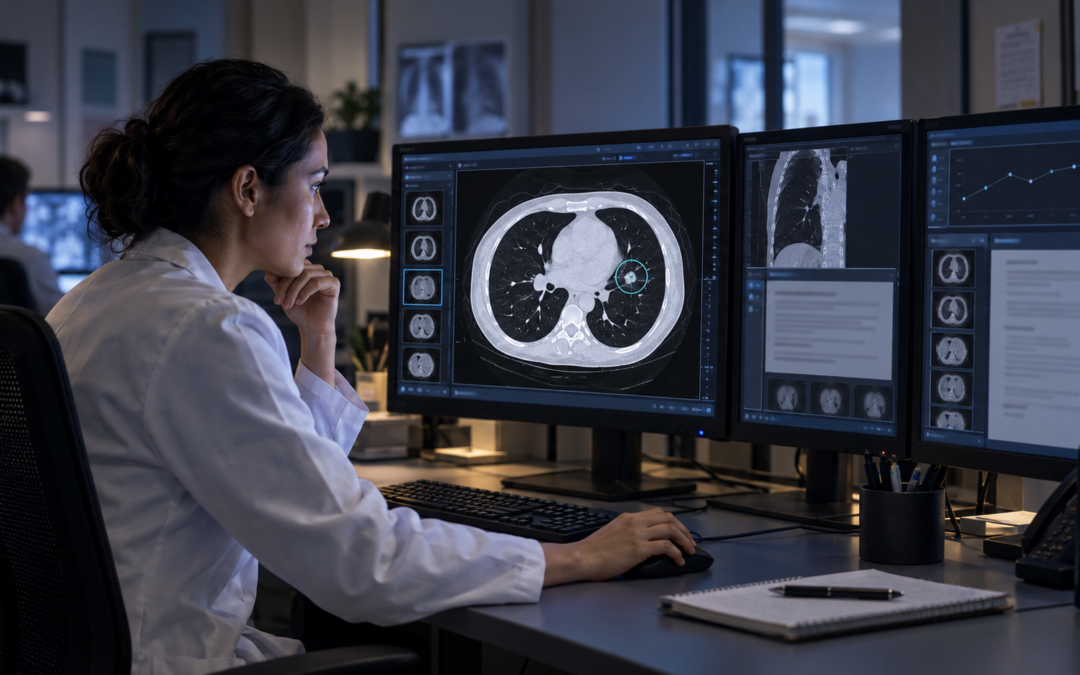
Why the difference between Computer-Aided Detection and AI is really a data story
There was a time when ‘advanced imaging’ meant something pretty simple. You opened a study, and the system drew a few circles. In effect: “Look here.”
That was Computer-Aided Detection. CAD. And for a while, it felt like the future. But if we’re being honest, many radiologists learned to treat those circles the same way we treat a car alarm in a parking lot: acknowledge it, maybe glance in the direction, and then get on with the real work.
Because CAD didn’t necessarily understand anything. It just pointed. And that difference, the gap between pointing and understanding, is exactly where the conversation about AI in radiology begins.
The CAD Era: finding needles, creating noise
Early CAD was heavily rules-based. Hand-crafted features. Thresholds. Patterns. Over time, machine learning entered the picture too. But the job remained narrow: identify a suspicious pattern in an image and flag it for the radiologist. If the density looks like this, flag it. If the shape looks like that, mark it. If the edge falls within a threshold, draw a box.
It was engineered pattern recognition. Focused. Task-specific. And, particularly in its earlier forms, relatively static. In very specific use cases, it worked. Mammography is the classic example. Lung nodule detection is another. CAD was designed to be a second set of eyes. But it wasn’t always a very discerning one. In some applications, sensitivity came at a price. Lots of flags. Lots of false positives. And over time, a lot of noise for the radiologist to filter out. In mammography, for example, a large study involving more than 323,000 women found that CAD did not improve diagnostic performance across the measures assessed.
So, what happened? Radiologists adapted. They learned to filter it out. Because CAD didn’t reduce uncertainty; it often added to it. It told you where to look. It didn’t tell you what you were looking at.
The AI shift: from highlighting to understanding
AI changed the ambition. Instead of explicitly defining every feature or threshold, we increasingly train models to learn patterns from data. Feed them thousands of images. Sometimes millions. And, depending on the use case, layer in diagnoses, outcomes, and context. Let the model learn what matters.
Now instead of: “Look here.”
You might get:
- “This looks like a malignancy.”
- “Probability 87%.”
- “Similar to these prior cases.”
- “Prioritize this study.”
So, instead of simply directing a radiologist to focus on a specific flag, an AI tool might estimate the likelihood of malignancy, segment a lesion, prioritize a study or help identify patterns that warrant closer attention. That’s not just detection. That’s a broader form of interpretation and decision support. AI is moving medical imaging beyond simple detection into a much wider range of clinical and workflow tasks.
And that’s where things start to feel different, not just technically, but operationally. Because once a system can interpret, it can prioritize. Once it can prioritize, it can influence workflow. Once it influences workflow, it starts to shape care. That’s a very different conversation than drawing circles.
But here’s the part we don’t talk about enough
Most of the conversation around AI focuses on the model. Accuracy. Sensitivity. Specificity. ROC curves.
All important.
But in real-world healthcare environments, those aren’t always the hardest problems. The hardest problem can be data. Because AI doesn’t operate in isolation. And the more ambitious the use case becomes, the more valuable context becomes. In many organizations, that context is fragmented.
Imaging data sits in PACS. Reports live somewhere else. Labs, in another system. Legacy data, if it’s accessible at all, is scattered across retired applications that are still running ‘just in case’. So, we end up trying to build AI on top of a data landscape that was never designed for it. And that’s where things start to break down.
CAD could live in a silo. AI needs more
This is the fundamental difference that often gets missed.
A narrow CAD task could often operate entirely within a modality or PACS. And, to be fair, some AI still can. If the job is simply to find a particular pattern in a single study, the study itself may be enough.
But the more we ask AI to understand about the patient, the harder that silo becomes to defend. Prior imaging starts to matter. So does clinical history. Lab data. Reports. Outcomes. The broader story around the image.
That isn’t just theory. A Radiology analysis of imaging AI found that most applications examined used data from a single point in time, even though many real diagnostic and prognostic decisions depend on longitudinal information and comparison with prior examinations.
And there are signs that adding that context can improve the result. In one 2024 multicenter prostate MRI study, AI combining imaging findings with clinical information outperformed the imaging-only model.
And that’s where imaging becomes more than imaging. Because a DICOM imaging object can contain far more than the image itself. There’s acquisition context. Modality parameters. Timing. Protocol. Patient demographics. Information that, when surfaced and normalized, becomes incredibly powerful. Not just for detection, but for analytics, population health, and predictive modeling.
For example:
- You’re not just identifying nodules – you’re correlating imaging findings with smoking history, lab values, and outcomes
- You’re not just reading today’s scan – you’re putting it in the context of what came before.
But that only works if the data is accessible.
The Illusion of ‘AI Readiness’
A lot of organizations believe they’re ready for AI because they’ve invested in tools. They’ve deployed algorithms. They’ve run pilots. They’ve integrated viewers.
But AI readiness isn’t about tools. It’s about whether your data can be used. That means more than simply having the data somewhere. It needs to be accessible, complete enough for the task, consistent and trustworthy. Those are the same kinds of data-accessibility and data-quality issues NIST identifies as foundational to healthcare AI.
- Can you access historical imaging without spinning up legacy systems?
- Can you correlate imaging with labs and reports?
- Can you query across populations, not just studies?
- Can you trust the data you’re feeding into your models?
If the answer to those questions is no, then AI doesn’t fail because of the algorithm. It fails because of the foundation.
From system-centric to patient-centric
This is where architecture starts to matter. Traditional environments are system-centric. Each application owns its own data. Each archive is tied to a workflow. Each dataset lives in its own silo. And every time you need context, you have to go find it. That model worked when the goal was storage and retrieval. It doesn’t work nearly as well when the goal is intelligence.
AI increasingly benefits from a patient-centric view. A place where imaging, documents, discrete data, and history are brought together. Where metadata is normalized. Where data can be accessed through standard interfaces. Where the system isn’t just storing data but organizing it in a way that makes it usable.
That’s where a patient-centric data layer, such as a Clinical Data Repository, starts to matter. Not because a repository is ‘AI’ in itself, but because it can provide a persistent, governed layer where clinical information from different systems can be brought together and made available without forcing every downstream use case back into the systems that originally created it.
At BridgeHead, that’s the role HealthStore® is designed to play: consolidating live and legacy clinical information – including images, documents and discrete data – while making that information available through standards-based access for the systems and people that need it.
Because intelligence doesn’t come from isolated datasets. It comes from connections.
The real evolution
If you step back, the evolution from CAD to AI isn’t just a technology shift. It’s a maturity shift in what we expect the technology to do. CAD was about augmenting the radiologist’s eye. AI is about augmenting a much broader range of clinical decisions and workflows. And that requires more than better algorithms.
It requires:
- Better data
- Better access
- Better structure
- Better governance.
Because the organizations that succeed with AI won’t be the ones with the most models. They’ll be the ones that can actually use their data.
The bottom line
CAD drew circles. AI draws far more ambitious conclusions. But neither matters if the data behind them is incomplete, inaccessible, or fragmented.
So the real question isn’t:
“Do we have AI?”
It’s:
“Can our data support intelligence?”
Because until that answer is yes, AI isn’t a transformation. It’s just a more sophisticated way of drawing circles.
Bobby Edwards joined BridgeHead Software in October 2011 and brings more than 25 years of extensive experience in healthcare and data management. In his current role as Principal Solutions Consultant – HealthStore, he is entrusted with the responsibility of actively engaging with hospitals, listening to their unique challenges, and devising innovative solutions to address complex data management issues. His goal is to enhance healthcare delivery and positively impact people’s lives through his work.
Bobby has held senior positions within prominent technology and development organizations, including eMed Technology and Iron Mountain, before joining BridgeHead Software.

